Get the Tata Capital App to apply for Loans & manage your account. Download Now

Blogs

SUPPORT

Tata Capital > Blog > Loan for Home > What is a partition deed for ancestral property?

Loan for Home

What is a partition deed for ancestral property?

What is a partition deed for ancestral property?

Since the joint family structure is quite common in India, it often leads to disputes amongst the family members who are co-owners of ancestral property. The joint ownership of a property can become the cause of conflicts and arguments, especially when dividing the property share.

In such a scenario, the property partition deed is a legal instrument that aids co-owners to split their shares and acquire rights over the property.

Why does the need for partition arise?

When a few parties own a piece of land or built property jointly, they may have different interests and plans regarding the property. The need for partition arises when the co-owners decide to follow different paths. One may want to reside in the property, while the other may want to sell it. Since the property does not have clear divisions and is owned jointly, it becomes challenging to divide it into equal shares. This is where the partition deed can help.

Also, read – Understanding Declaration Deeds for Property Ownership

What is the partition deed for a property?

Co-owners of a property can use this legal instrument to obtain their share rightfully. After the execution of this deed, all the co-owners will get equal shares of the property and will acquire full ownership rights. This empowers them to be able to sell, rent, or gift the property according to their will. Essentially, each member will become an independent owner of the divided property.

When can you execute the deed?

There are primarily two scenarios. In a partition deed, ancestral property gets divided from one piece into several shares, and the ownership of each share also changes. If there is mutual consent from all the co-owners, then the deed can be executed efficiently. However, if you want to execute the deed without mutual consent, you will have to file a lawsuit.

Also, read – Mortgage Deed: Meaning, Types & Importance

How is property divided under a partition deed?

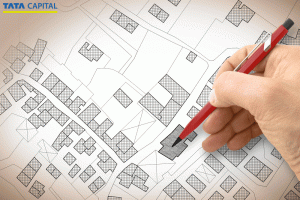
Suppose a family owns an asset spread across 3 acres. Each owner of the asset gets a share based on what is mentioned in the partition deed. This share is either equal or as per legal entitlement. The process of property division under a partition deed is usually done by metes and bounds. There are clear boundaries and mention of ownership details.

For example, if three siblings jointly own a residential plot, the partition deed may divide it into three equal portions. It will mention which sibling receives the front, middle, and rear portions, respectively. 

Also, read – What Is Sale Deed In Home Loan?

Legal requirements and documents for a partition deed

Proper execution, adequate stamping, and registration of a partition deed are essential. Non-compliance with a partition deed’s legal requirements can weaken its value as evidence and lead to future disputes.

Take a look at the partition deed checklist given below:

  • Consent of all co-owners: Every legal heir or co-owner must agree to the partition.
  • Adequate stamp duty: Stamp duty must be paid as per applicable state laws.
  • Mandatory registration: Validity of a partition deed is secured after registration at the sub-registrar’s office.
  • Clear share allocation: It must mention exact shares and property descriptions.
  • Necessary documents: You require title deeds, identity proofs, and address proofs.
  • Witness signatures: There should be two witnesses while registering the deed.

Step-by-step guide to registering a partition deed in India

If you want to register a partition deed in India, the partition deed registration process is as follows:

  1. Draft the partition deed: Mention property details, shares of each co-owner, and terms of division.
  2. Calculate stamp duty: Look at the state laws to determine applicable stamp duty and registration charges.
  3. Buy stamp paper: You need to purchase stamp paper of the right value to prepare the deed. You may also opt for e-stamping.
  4. Fix a registration appointment: Book a slot at the local sub-registrar’s office where the property is located.
  5. Appear before the registrar: All parties must be present with valid identity proofs and original documents.
  6. Verification and registration: Every detail mentioned in the deed is verified by the registrar. Biometrics are also recorded.
  7. Collect the registered deed: You must have a certified copy of the deed. It helps to maintain the future legal and ownership records.

Also, read – Relinquishment Deeds: Meaning, Benefits & Registration Process

Difference between a partition deed and a partition agreement

It is essential to understand the difference between a partition deed and an agreement. The following table compares the partition deed vs agreement on various parameters.

BasisPartition deedPartition agreement
NatureA formal legal document that clearly divides jointly owned property.A mutual understanding or arrangement among co-owners for division.
RegistrationMandatory registration under the Registration Act for legal validity.Registration is optional but recommended to put the partition deed in enforcement. 
Stamp dutyStamp duty is compulsory and varies as per state laws.Lower stamp duty may apply based on state laws.
Legal validityCreates clear, legally enforceable ownership rights.Legal standing is limited if unregistered.
Use in courtFully admissible as evidence.May face evidentiary challenges if disputed.
Best suited forPermanent and final partition of property.Temporary or preliminary understanding among parties.

Common mistakes to avoid in drafting a partition deed

The most common drafting errors in a partition deed are:

  • Excluding legal heirs: Failing to include all co-owners or legal heirs can make the deed invalid and lead to future legal challenges.
  • Vague property details: Unclear boundaries, incorrect survey numbers, or missing measurements often cause disputes and registration issues.
  • Improper share allocation: Not clearly defining each party’s share or possession rights can create ambiguity in ownership.
  • Incorrect stamp duty payment: Penalties or registration delays are common due to underpayment or the use of the wrong stamp paper.
  • Avoiding registration: It is not possible to legally enforce a partition deed that is not registered.
  • Ignoring witness signatures: Absence of witnesses can weaken the deed’s evidentiary value.

Also, read – What Is MODT in Home Loan? Meaning, Full Form & MODT Charges

Can you sell your share after the partition deed execution?

Yes, you can sell an inherited property share after the execution and registration of a partition deed. Once the deed is legally registered, joint ownership comes to an end, and each co-owner becomes the absolute owner of their allotted share. This gives you the legal right to sell, gift, or mortgage your portion independently without consent from other parties. The sale must follow relevant property laws and zoning rules. Another point to keep in mind is that the deed must clearly highlight ownership and boundaries of each co-owner.

Also, read – Conveyance Deed: Meaning, Types & What Is It?

Partition deed and ancestral property rights under the Hindu Succession Act

The ancestral property rights and partition deed under the Hindu Succession Act are as follows:

  • Coparcenary rights by birth: Under the Hindu Succession Act, ancestral property is jointly owned by coparceners, and rights arise by birth.
  • Equal rights for daughters: According to the 2005 amendment, daughters must be granted the same coparcenary rights as sons. This impacts the execution of partition deeds.
  • Consent of all coparceners: A valid partition deed must include all living coparceners with legal entitlement.
  • Defined share allocation: Shares are determined as per succession laws at the time of partition.
  • Registration requirement: The partition deed must be properly stamped and registered to be legally enforceable.
  • Final settlement: Once executed, the deed legally ends joint ownership, and individual rights become absolute.

Final thoughts

If you have just sold your ancestral property or plan to move into a new home, you might need a home loan to finance the purchase. At Tata Capital, you can get highly attractive home loan interest rates and enjoy quick loan disbursal!

We provide easy-to-fulfill home loan eligibility and minimal documentation, so you can move into your dream home as quickly as possible. Apply for a home loan ranging from Rs. 5 lakh up to Rs. 5 crore by visiting our website today or simply download the Tata Capital Home Loan App!

More About Loans

FAQs

How is stamp duty calculated on a partition deed?

Stamp duty on a partition deed is calculated based on the state-specific stamp laws. Generally, it depends on whether the property is divided among family members or others, the market value of the separated share, and whether the partition is by metes and bounds.

Can a partition deed be executed for non-ancestral property?


Yes, a partition deed can be executed for non-ancestral or self-acquired property if the owner voluntarily agrees to divide the property among legal heirs or co-owners.

What is the impact of the 2005 Hindu Succession Act amendment on partition deeds?


The 2005 amendment grants daughters equal coparcenary rights in ancestral property by birth, similar to sons. This significantly impacts partition deeds, as daughters must be included as equal stakeholders in partitions executed after the amendment.

How long does partition deed registration take?


Partition deed registration typically takes one working day at the sub-registrar’s office if documents are complete. However, certified copies and final registration records may take a few days to a couple of weeks, depending on the state process.

Can partial partition deeds be made?


Yes, partial partition deeds can be made. Suppose a family has 3 jointly owned assets. It can divide 1 and keep the other 2 jointly owned. The partial partition deed must clearly specify the details of the asset being partitioned. This ensures that there are no disputes in the future.

What are the legal consequences of not registering a partition deed?


An unregistered partition deed has limited legal validity and cannot be relied upon as evidence of title in court. It may also be inadmissible for mutation, resale, or loan purposes. Disputes and ownership challenges are also common if you don’t register a partition deed.

Is a partition deed enforceable without witnesses?


Having witnesses during the partition deed registration is strongly recommended. A partition deed without witnesses may still be registered, but the absence of witnesses can weaken its evidentiary value if the deed is later challenged in court.

How to correct mistakes in a partition deed?


Mistakes in a partition deed can be corrected by executing a rectification deed with the consent of all parties. The rectification deed must clearly mention the errors and corrections. You must also get it stamped and registered.