Get the Tata Capital App to apply for Loans & manage your account. Download Now

Blogs

SUPPORT

Tata Capital > Blog > Loan on Property > What is Annual Percentage Rate (APR) and how is APR calculated?

Loan on Property

What is Annual Percentage Rate (APR) and how is APR calculated?

What is Annual Percentage Rate (APR) and how is APR calculated?

Annual Percentage Rate (APR) helps you understand the actual cost of a loan by combining the interest rate with certain fees and charges. It is one of the most useful tools for comparing loans, credit cards, and other borrowing options. Unlike a simple interest rate, APR gives a broader view of what you may end up paying over the loan term. Understanding how APR is calculated can help you make better borrowing decisions and avoid costly surprises. Before taking any loan, it is always a good idea to compare the APR offered by different lenders.

APR is the yearly cost of borrowing money, including the interest rate and certain loan-related charges, expressed as a percentage.

Have you ever noticed that two loans with the same interest rate can end up costing very differently in reality? Many borrowers focus only on the advertised interest rate and overlook the additional charges that come with a loan. This is where APR becomes important. The APR full form is Annual Percentage Rate, and it gives you a more complete picture of the actual cost of borrowing by including not just the interest rate but also certain fees and charges.

Understanding what APR is can help you compare loan offers more accurately and make well-informed borrowing decisions. In this guide, we explain the meaning of APR, how it works, its types, and how it is calculated with examples. We have also explained the difference between APR and interest rate for better understanding. Keep reading.

Also Read – Fixed vs floating interest rate

What Is Annual Percentage Rate (APR)?

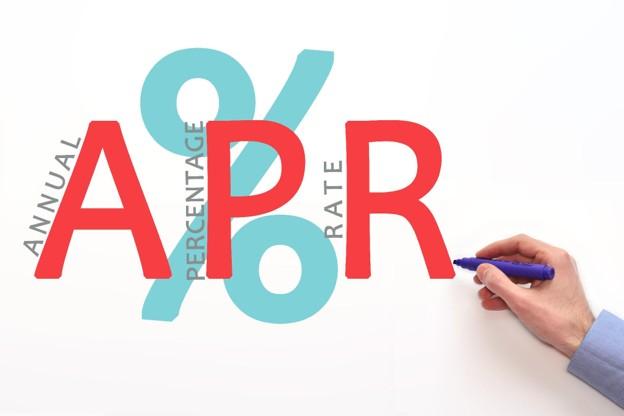
As you already know, the APR full form is Annual Percentage Rate. Now, coming to the question of what APR is, it is the total yearly cost of a loan or credit product. It includes not only the interest charged by the lender but also certain fees and charges associated with the loan.

Unlike the Rate of Interest (ROI), which reflects only the interest component, APR provides a more complete picture and helps borrowers compare different loan offers more accurately. The APR percentage can be calculated using a mathematical formula that accounts for the loan amount, tenure, interest, and applicable charges.

How does APR work?

APR is expressed as an annual percentage and shows the actual cost of borrowing money. It estimates the percentage of the loan amount you pay each year after taking into account not only the interest rate but also certain fees and charges associated with the loan.

This is why the APR percentage is often considered more useful than the headline interest rate alone. In many lending products, APR is required to be disclosed to improve transparency and help borrowers understand the real cost of a loan before making a borrowing decision.

Read More – Hidden charges in personal loans

What Are the Different Types of APR?

Not every loan or credit product uses the same type of APR. The rate applied depends on the purpose of the borrowing and the terms offered by the lender.

  • Fixed APR: The APR remains the same for a specified period, making it easier to estimate borrowing costs.
  • Variable APR: The APR can change over time if the benchmark rate or market conditions change.
  • Purchase APR: This is the rate charged on purchases made using a credit card.
  • Cash Advance APR: Applies when you use a credit card to withdraw cash. It is often higher than the rate charged on purchases.
  • Balance Transfer APR: Charged when outstanding dues are transferred from one credit card to another.
  • Introductory or Promotional APR: A temporary low or zero-rate offer provided for a limited period, usually to attract new customers.

How is APR calculated? Formula and example

Along with “what is APR”, “how to calculate APR” is another common question borrowers ask.

APR = [{(Fees + Interest) / Principal} / N] X 365 X 100

  • Fees = processing fee and other charges
  • Interest = total interest payable during loan term
  • Principal = original loan amount sanctioned
  • N = number of days in loan term

Consider a loan of Rs. 1,00,000 taken for one year at 10% interest, with processing fees and other charges of Rs. 2,000:

  • Total interest for the year: Rs. 10,000.
  • Interest plus fees: Rs. 10,000 + Rs. 2,000 = Rs. 12,000.
  • Divide by the principal: Rs. 12,000 ÷ Rs. 1,00,000 = 0.12.
  • Adjust for the loan term and annualise: 0.12 ÷ 365 days × 365 days = 0.12.
  • Convert to a percentage: 0.12 × 100 = 12%.

The APR for this loan works out to 12%, which is higher than the 10% ROI, since it also accounts for the Rs. 2,000 in charges.

APR Calculation for a Loan

For a loan, APR includes both the interest cost and applicable fees. For example, if you borrow Rs. 5,00,000 for two years at 9% interest, and pay Rs. 8,000 in processing fees and other charges, the APR works out to 9.8%, just under a percentage point above the stated interest rate. This gives a clearer picture of the total borrowing cost than the interest rate alone, making it easier to compare loan offers from different lenders.

APR Calculation for a Credit Card

For a credit card, APR is usually converted to a daily periodic rate by dividing it by 365. Interest is then charged daily on the unpaid balance. For example, if the APR is 36%, the daily rate is about 0.099%. If you carry a balance from one billing cycle to the next, interest continues to accrue. However, paying in full within the interest-free period helps avoid APR charges.

Also Read – How To Improve Credit Score In 30 Days

APR vs ROI: What is the difference?

Many borrowers confuse APR with ROI (Rate of Interest). While both are shown as percentages, APR also includes certain fees and charges, whereas ROI reflects only the interest component of a loan.

BasisAPRROI
What does it include?Interest plus certain fees and charges.Only the interest charged on the loan.
What does it show?The overall cost of borrowing.The rate at which you have to pay interest on a loan.
Useful forComparing different loan offers.Understanding the interest component.
Which is higher?APR is higher than ROI because it considers additional charges.ROI is lower because it considers only the interest rate.

APR provides a more complete picture for comparing loan offers, while ROI focuses only on the interest component of your borrowing cost.

APR vs APY: How are they different?

APR and APY are both expressed as annual percentages, but they measure different things. APR stands for Annual Percentage Rate and is commonly used to show the cost of borrowing money through loans or credit cards. It does not account for compounding effects within the year. APY stands for Annual Percentage Yield, and is generally used for savings accounts, fixed deposits, and other investment products. It includes the effect of compounding, which means it reflects the actual return earned over a year. In simple terms, APR helps you understand borrowing costs, while APY helps you understand investment or savings returns.

BasisAPRAPY
Used forBorrowing, such as loans and credit cardsSavings, fixed deposits, and other investments
Accounts for compounding?NoYes
What it tells youThe cost of borrowing moneyThe actual return earned on savings or investments
Generally preferred asLowerHigher

Check – Housing Loan Online

Fixed vs Variable APR: What Is the Difference?

The APR on a loan can either stay the same or change over time. With a fixed APR, the rate remains unchanged during the fixed-rate period, so your repayments stay predictable. This is often seen in products such as a fixed-rate mortgage. With a variable APR, the rate can go up or down depending on changes in market or benchmark rates. As a result, your borrowing cost and monthly payments may also change during the loan term.

Why Does APR Matter When Borrowing?

Many borrowers look only at the advertised interest rate while comparing loans. However, the interest rate does not always tell the full story. Since APR includes both the interest cost and certain fees, it gives a more realistic view of what a loan may actually cost.

  • Helps compare loans and credit cards on a fair basis.
  • Shows the impact of fees and charges on borrowing costs.
  • Makes it easier to identify expensive loan offers.
  • Reduces the chances of being misled by a low headline interest rate.
  • Helps borrowers make more informed financial decisions.
  • A lower APR usually means a lower overall borrowing cost.

How to Get a Lower APR on a Loan?

  • Maintain a healthy CIBIL score by paying EMIs and credit card bills on time.
  • Compare APRs from multiple lenders instead of looking only at the interest rate.
  • Ask the lender whether any processing fees or charges can be reduced.
  • Opt for a shorter loan tenure, as it may lower the overall borrowing cost.
  • Opt for a secured loan instead of an unsecured loan where feasible.
  • Keep your debt levels under control to strengthen your credit profile.
  • Submit complete and accurate documents to support your application.

Lenders like Tata Capital offer competitive rates and transparent charges that help borrowers maintain a lower APR.

Conclusion

APR gives you a clearer picture of what a loan or credit product may actually cost because it includes both the interest rate and certain fees. For this reason, it is often the most useful number to compare when evaluating different borrowing options. Before taking a loan, make sure you check the APR, not just the advertised interest rate.

More About Loans

FAQs

What is APR?

APR is a way of showing how much a loan really costs in a year. It includes the interest you pay and some of the charges linked to the loan. This makes it easier to understand the overall borrowing cost instead of looking only at the interest rate.

What is the full form of APR?

The APR full form is Annual Percentage Rate. It is shown as a percentage and helps borrowers understand the yearly cost of a loan or credit product. Lenders often disclose APR so that customers can compare different borrowing options more easily.

How is APR calculated?

APR is worked out using the loan amount, interest payable, loan tenure, and certain charges such as processing fees. The goal is to convert all these costs into a single annual percentage. This helps borrowers see the total cost of borrowing in one number.

What is the difference between APR and interest rate?

The interest rate only shows the cost of borrowing the loan amount. APR goes a step further and also takes some fees and charges into account. Because of this, APR usually gives a better idea of what the loan may actually cost over time.

Is a lower APR better?

In most situations, a lower APR is preferable because it generally means you will spend less money on the loan. However, it is still important to look at other factors such as repayment terms, loan features, and any conditions attached to the offer.

What is a good APR on a loan in India?

There is no fixed number that can be called a good APR for everyone. The APR offered depends on factors such as your credit score, income, loan type, and the lender's policies. Borrowers with stronger credit profiles are usually offered lower APRs.

Does APR include processing fees?

Yes, APR generally includes processing fees and some other loan-related charges. That is why it is often higher than the advertised interest rate. However, the exact charges included in APR can differ from one lender or product to another.

What is the difference between fixed and variable APR?

With a fixed APR, the rate stays the same during the fixed-rate period, so the borrowing cost remains predictable. With a variable APR, the rate can change if market rates move up or down. This means your borrowing cost may also change over time.

Can APR change during the loan tenure?

It depends on the type of loan. A fixed-APR loan keeps the same rate for the agreed period, so your EMI stays predictable. A variable-APR loan can move up or down if the lender's benchmark rate changes, which then adjusts your EMI or tenure. Check your loan agreement to see which type applies to you.

Is a lower APR always better?

Usually, yes, since it points to a lower overall cost. But it's worth checking what that APR actually includes. A slightly higher APR bundled with genuinely useful terms, like a longer repayment window or lower prepayment charges, can sometimes work out better for your situation than the lowest number on offer.

How does APR help compare loan offers?

Because APR folds in fees and charges along with the interest rate, it lets you compare two loans on a like-for-like basis, even when their headline interest rates look identical. A loan with a lower interest rate but heavy processing fees can end up with a higher APR than one with a slightly higher rate and fewer charges.

Where can I find the APR on a loan agreement?

Lenders are required to disclose the APR in the loan agreement or the Key Fact Statement (KFS) shared before you sign. If you can't locate it, ask your lender directly. Reviewing this figure alongside the EMI schedule gives you the clearest sense of what the loan will actually cost.