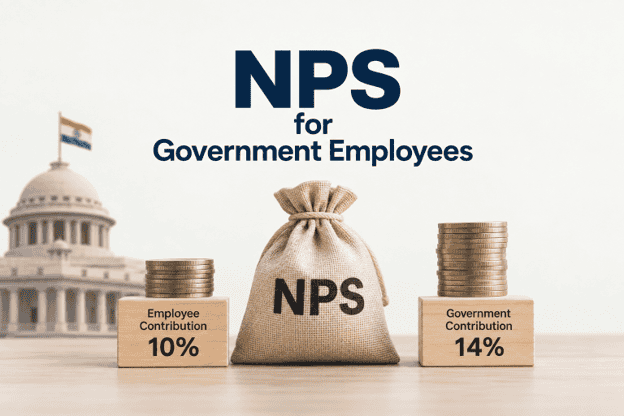
Summary: NPS for government employees works through contributions from the employee and the Government, with the accumulated amount invested according to the applicable NPS investment choices. Central Government employees under NPS contribute 10% of Basic Pay plus DA, while the Government contributes 14%. This guide explains the contribution rules, NPS calculator, investment choices, tax treatment, withdrawal rules and the distinction between NPS and other pension arrangements.
Central Government employees who joined service on or after 1 January 2004, excluding the armed forces, are covered under the National Pension System (NPS). Under the current NPS structure, the employee contributes 10% of Basic Pay plus Dearness Allowance (DA), while the Central Government contributes 14% of Basic Pay plus DA to the Tier 1 account.
For eligible Central Government employees, the Unified Pension Scheme (UPS) has also been available as an option under the National Pension System from 1 April 2025. The rules applicable to a particular employee can depend on whether the employee remains under NPS or has opted for UPS.
An NPS calculator for govt employees can help estimate the possible retirement corpus by using inputs such as current Basic Pay and DA, years remaining until retirement, contribution rate and an assumed rate of return. Note that the result is an estimate and not a guaranteed pension or corpus.
NPS for Government Employees: An Overview
The Central Government introduced NPS with effect from 1 January 2004, initially covering Central Government employees joining service from that date, except armed forces personnel. NPS follows a defined-contribution structure, meaning the retirement corpus is built from contributions and the investment performance of those contributions.
For a Central Government employee under NPS, both the employee and Government contribute to the Tier 1 account each month. The employee contributes 10% of Basic Pay plus DA, while the Government contributes 14%. These contributions are linked to the employee’s PRAN and are invested through registered Pension Fund Managers according to the applicable investment choice.
NPS is different from the earlier defined-benefit pension structure commonly associated with the Old Pension Scheme (OPS). Under a defined-contribution arrangement, the value of the retirement corpus depends on contributions and investment performance instead of being calculated solely as a predetermined percentage of final salary.
The pension framework for Central Government employees has also evolved with the introduction of UPS as an option under NPS from 1 April 2025. UPS has its own contribution and payout structure and should not be treated as identical to the standard NPS structure.
An NPS calculator for govt employees is an estimation tool that projects how the accumulated NPS corpus could grow based on the information entered by the user. It does not determine the actual pension payable after retirement because the final corpus depends on actual contributions, investment performance, retirement timing and the applicable exit rules.
A government employee generally needs inputs such as:
Current Basic Pay plus DA: This forms the salary base used to calculate the mandatory NPS contribution for Central Government employees.
Years Remaining Until Retirement: A longer contribution period gives the existing corpus more time to remain invested.
Annual Salary Growth Assumption: This can be used to estimate how future contributions may increase as Basic Pay changes.
Expected Rate of Return: This is an assumption entered into the calculator. It should not be treated as a guaranteed NPS return.
Contribution Rate: For Central Government employees under NPS, the standard employee contribution is 10% of Basic Pay plus DA and the Government contribution is 14%.
What Does the NPS Calculator Show?
Depending on the calculator, the output can include:
Estimated corpus at retirement
Total contributions over the investment period
Estimated growth on the contributions
Potential lump-sum amount at exit
Amount that may be used for annuity purchase
The calculator’s output changes when the assumptions change. For example, increasing the assumed annual salary growth can increase projected future contributions, while changing the assumed rate of return can materially change the estimated corpus.
Illustrative Example
Suppose a Central Government employee has ₹50,000 as Basic Pay plus DA at a particular point in service.
The monthly contributions under the standard NPS structure would be:
Contribution
Rate
Monthly amount
Employee
10%
₹5,000
Government
14%
₹7,000
Total
24%
₹12,000
This ₹12,000 is the contribution for that month based on the assumed ₹50,000 Basic Pay plus DA. Actual contributions can change as the employee’s salary changes.
The example is illustrative only. It does not represent a projected retirement corpus because a corpus calculation would also require the employee’s current age, years to retirement, salary-growth assumption and assumed investment return. For a current calculation, you can use the NPS Calculator on NPS Trust.
NPS Contribution Rules for Government Employees
For Central Government employees covered under NPS, the contribution structure is quite simple:
Contributor
Contribution
Calculation base
Employee
10%
Basic Pay + DA
Central Government
14%
Basic Pay + DA
Total
24%
Basic Pay + DA
The Government’s contribution was increased from 10% to 14% following the 2019 changes to the Central Government NPS contribution structure. The current PFRDA rules continue to specify a 10% employee contribution and 14% Government contribution for Central Government employees under NPS.
For example, if Basic Pay plus DA is ₹60,000 for a month, the employee contribution would be ₹6,000 and the Government contribution would be ₹8,400. The total monthly contribution would therefore be ₹14,400.
State Government employees do not necessarily follow the same contribution rate. Their applicable contribution depends on the rules adopted by the respective State Government.
It is also important to distinguish NPS from UPS. Under UPS, the contribution structure is different. The employee contributes 10% of Basic Pay plus DA, the Government contributes a matching 10% to the individual corpus and the Government also makes an additional contribution to the Pool Corpus under the UPS framework.
Therefore, the 10% employee plus 14% Government structure should be used specifically for Central Government employees remaining under NPS, rather than being applied to every government employee or to UPS subscribers.
Besides government contribution, the main features relevant to government employees include:
Tax Deduction on Own Contribution: Eligible employee contributions can qualify for deductions under Section 80CCD(1), subject to the applicable conditions and limits.
Additional ₹50,000 Deduction: Section 80CCD(1B) provides an additional deduction of up to ₹50,000 for eligible own NPS contributions under the applicable tax rules.
Employer Contribution Deduction: Government contributions to NPS are separately covered under Section 80CCD(2), subject to the prescribed limits.
Market-linked Accumulation: Contributions are invested in permitted NPS asset classes, so the eventual corpus depends partly on investment performance.
Portability: The NPS account is linked to the subscriber’s PRAN, thereby allowing the pension account to continue when the employee moves between eligible postings or departments, subject to the applicable government-sector processes.
Online Access: Subscribers can use the CRA and NPS online services to access account-related information and contribution services. PFRDA provides online PRAN and NPS service facilities for Central Government subscribers.
Important: NPS does not provide a guaranteed investment return. The retirement corpus can vary because the underlying investments are market-linked.
A government employee’s NPS contribution is invested through a Pension Fund Manager rather than remaining as an idle account balance.
The main asset classes under NPS are:
E: Equity and equity-related instruments
C: Corporate debt
G: Government securities
A: Alternative assets, where applicable
Government-sector subscribers have investment choices prescribed under the applicable NPS framework. PFRDA has also expanded investment choices available to eligible Central Government and Central Autonomous Body subscribers through changes notified in 2025 and 2026.
Depending on the applicable choice, the investment allocation may be selected by the subscriber or determined through a lifecycle-based approach. Under a lifecycle approach, the allocation changes with age instead of remaining fixed throughout the subscription period.
For Central Government subscribers, the current investment-choice framework includes options such as the Default Scheme and lifecycle choices. PFRDA has issued subsequent updates to investment choices, so the available options should be checked against the current CRA/PFRDA framework rather than relying on an old list of fund choices.
Government employees can also choose from the Pension Fund Managers empanelled under the applicable NPS framework, subject to the choices available to their sector and the prevailing PFRDA rules.
Since NPS investments are market-linked, the return used in an NPS calculator for central government employees is an assumption for projection purposes. It should not be presented as an expected or guaranteed return.
Withdrawal rules depend on whether the subscriber is making a partial withdrawal during service or exiting NPS. For government-sector subscribers, the applicable exit rules also depend on the reason for exit and the accumulated pension wealth.
1. Withdrawal at Retirement
Under the current government-sector NPS exit framework, the withdrawal options at retirement or discharge depend on the accumulated pension wealth:
Accumulated Pension Wealth
Withdrawal at Retirement or Discharge
Up to ₹8 lakh
The entire amount can be withdrawn as a lump sum. Alternatively, up to 60% can be withdrawn as a lump sum and at least 40% can be used to purchase an annuity.
More than ₹8 lakh and up to ₹12 lakh
Up to ₹6 lakh can be withdrawn as a lump sum, with the balance handled through the permitted annuity or systematic withdrawal options.
More than ₹12 lakh
Up to 60% can be withdrawn as a lump sum and at least 40% must be used to purchase an annuity.
These provisions apply to government-sector NPS exits under the prevailing PFRDA regulations.
The lump-sum withdrawal and annuity purchase can be deferred subject to the conditions and timelines prescribed under the applicable NPS regulations.
2. Withdrawal on Resignation or Removal
If a government employee resigns or is removed from service, different exit rules apply:
If the accumulated pension wealth is up to ₹5 lakh, the entire amount can be withdrawn as a lump sum.
If the accumulated pension wealth is more than ₹5 lakh, up to 20% can be withdrawn as a lump sum, while at least 80% must be used to purchase an annuity.
3. Partial Withdrawal During Service
Partial withdrawal is permitted after the prescribed period and for specified purposes. Under the current NPS withdrawal framework, up to 25% of the subscriber’s own contributions can be withdrawn for permitted purposes, subject to the applicable conditions.
The permitted purposes can include specified requirements such as children’s education or marriage, purchase or construction of a residential house and specified medical or disability-related needs, subject to the applicable regulations.
The withdrawal is subject to the applicable conditions, including the prescribed minimum period of subscription and limits on the number of withdrawals.
4. Death of the Subscriber
In the event of the subscriber’s death, the accumulated pension wealth can be paid to the nominee or legal heir in accordance with the applicable NPS government-sector rules.
Under the current government-sector exit provisions, the treatment of the accumulated pension wealth depends on the amount available at the time of death:
Up to ₹8 lakh: The entire amount can be paid as a lump sum, subject to the applicable options.
More than ₹8 lakh and up to ₹12 lakh: Up to ₹6 lakh can be paid as a lump sum, with the balance handled through the permitted options.
More than ₹12 lakh: Up to 20% can be paid as a lump sum, while at least 80% is used for annuity.
The applicable benefits are paid to the nominee or legal heir in accordance with the prevailing PFRDA regulations. Because PFRDA has updated the NPS withdrawal framework, employees should check the latest government-sector exit and withdrawal rules before making a withdrawal request.
OPS and NPS follow different pension structures. A factual comparison helps explain the distinction without treating either system as universally preferable.
Feature
OPS
NPS
Structure
Defined-benefit pension
Defined-contribution pension
Pension calculation
Based on applicable government pension rules
Depends on accumulated pension wealth, applicable exit rules and annuity
Employee contribution
Generally no employee contribution to the pension under the traditional OPS framework
10% of Basic Pay + DA for Central Government employees under NPS
Government contribution
Government-funded pension obligation
14% of Basic Pay + DA for Central Government employees under NPS
Investment risk
Pension is not directly linked to market investment returns
Corpus is market-linked
Retirement income
Determined under applicable pension rules
Depends on corpus, annuity purchase and applicable exit rules
The Old Pension Scheme is associated with a defined-benefit structure, while NPS is based on defined contributions and market-linked investment of the accumulated pension wealth.
Some State Governments have changed their pension arrangements over time, including decisions relating to OPS and NPS. The rules therefore depend on the employee’s government, service category and applicable notifications.
For Central Government employees, UPS is another relevant framework because it was introduced as an option under NPS from 1 April 2025. UPS has an assured payout structure subject to prescribed conditions and should be considered separately from the standard NPS framework.
Conclusion
NPS for government employees combines employee and Government contributions to build a retirement corpus. For Central Government employees remaining under NPS, the employee contributes 10% of Basic Pay plus DA and the Government contributes 14% thereby making the total contribution 24% of the applicable salary base.
An NPS calculator for govt employees can help estimate how these contributions could accumulate over the remaining service period. However, the result depends on the assumptions entered into the calculator and the actual investment performance of the NPS portfolio.
Withdrawal rules determine how the accumulated corpus can be received at retirement, including different withdrawal options based on the accumulated pension wealth and the requirement to use at least 40% of the corpus for an annuity for pension wealth above ₹12 lakh, subject to the applicable rules.
Eligible Central Government employees should also distinguish between NPS and UPS, as the two have different contribution and payout structures. For information on retirement planning and related financial services, visit Tata Capital Wealth Services.
Disclaimer: NPS contribution rates, investment choices, withdrawal provisions and tax rules may be revised by PFRDA, the Central Government or through changes in applicable law. The information above is for general educational purposes and should be checked against the latest official rules applicable to the employee.
How do I use the NPS calculator for government employees?
To use an NPS calculator for govt employees, enter details such as current Basic Pay plus DA, years remaining until retirement, expected salary growth, contribution rate and an assumed investment return. The calculator then provides an estimated retirement corpus. The result is illustrative because actual NPS returns are market-linked.
What is the employer contribution to NPS for central government employees?
For Central Government employees covered under NPS, the Government contributes 14% of Basic Pay plus DA to the Tier 1 account. The employee contributes another 10% of Basic Pay plus DA. The combined monthly contribution is therefore 24% of Basic Pay plus DA under the standard Central Government NPS structure.
What is the total NPS contribution for a central government employee?
The total NPS contribution for a Central Government employee under NPS is 24% of Basic Pay plus DA each month. The employee contributes 10% and the Government contributes 14%. For example, on Basic Pay plus DA of ₹50,000, the combined monthly contribution would be ₹12,000.
How much corpus can a government employee accumulate in NPS?
There is no single fixed NPS corpus for government employees. The amount depends on the contribution base, years remaining until retirement, salary growth and investment performance. An NPS calculator for central government employees can provide an estimate by applying the assumptions entered by the user, but it cannot guarantee the final corpus.
Can central government employees choose their NPS fund manager?
Central Government subscribers can exercise investment and Pension Fund choices according to the options made available under the applicable NPS framework. PFRDA has expanded investment choices for eligible Central Government subscribers through recent changes, so employees should check the current CRA and PFRDA options rather than relying on an older list of available choices.
What are the NPS withdrawal rules for government employees at retirement?
At normal exit from government-sector NPS, the applicable withdrawal option depends on the accumulated pension wealth. For pension wealth up to ₹8 lakh, the entire amount can be withdrawn as a lump sum. For pension wealth above ₹12 lakh, up to 60% can be withdrawn as a lump sum and at least 40% must be used to purchase an annuity. Different provisions apply to pension wealth between ₹8 lakh and ₹12 lakh.





 07 October 2026
 12 mins read

 Previous Post